HEALTH & MIND · HEALTH FRONTIERS
Insights from PBM Mechanisms
From Mechanistic Hierarchy to Physiological Representation
Time is everywhere in biology, but it is usually treated as a measurement axis. We observe biological events across seconds, minutes, hours, days, or weeks, using time to locate when a change occurs and how long it persists. From a systems perspective, however, time also reveals something about biological organization.
Biological Mechanisms Within a Shared Time Structure
Biological mechanisms do not unfold independently and then simply add together. Multiple processes develop, overlap, interact, and recede along the same temporal axis. Each has its own temporal course, while their sequence, duration, overlap, and interaction together form the temporal structure of the mechanistic system.
Photobiomodulation (PBM) provides an interesting example.
PBM uses red or near-infrared light to modulate biological function. Its effects involve a broad and highly interconnected mechanistic system spanning mitochondrial bioenergetics, redox and calcium signaling, transcriptional regulation, inflammation, metabolism, and neuroplasticity. The complexity lies not simply in the number of mechanisms involved, but in how they interact across different levels of biological organization and unfold within a shared temporal structure.
A Mechanistic Hierarchy Within Time Structure
One way to organize this complexity is to view PBM mechanisms as a biological hierarchy operating over time.
This is not a single linear pathway. Different mechanisms interact, overlap, feed back on one another, and may operate simultaneously. The hierarchy instead describes different levels of biological organization within an interconnected regulatory system.
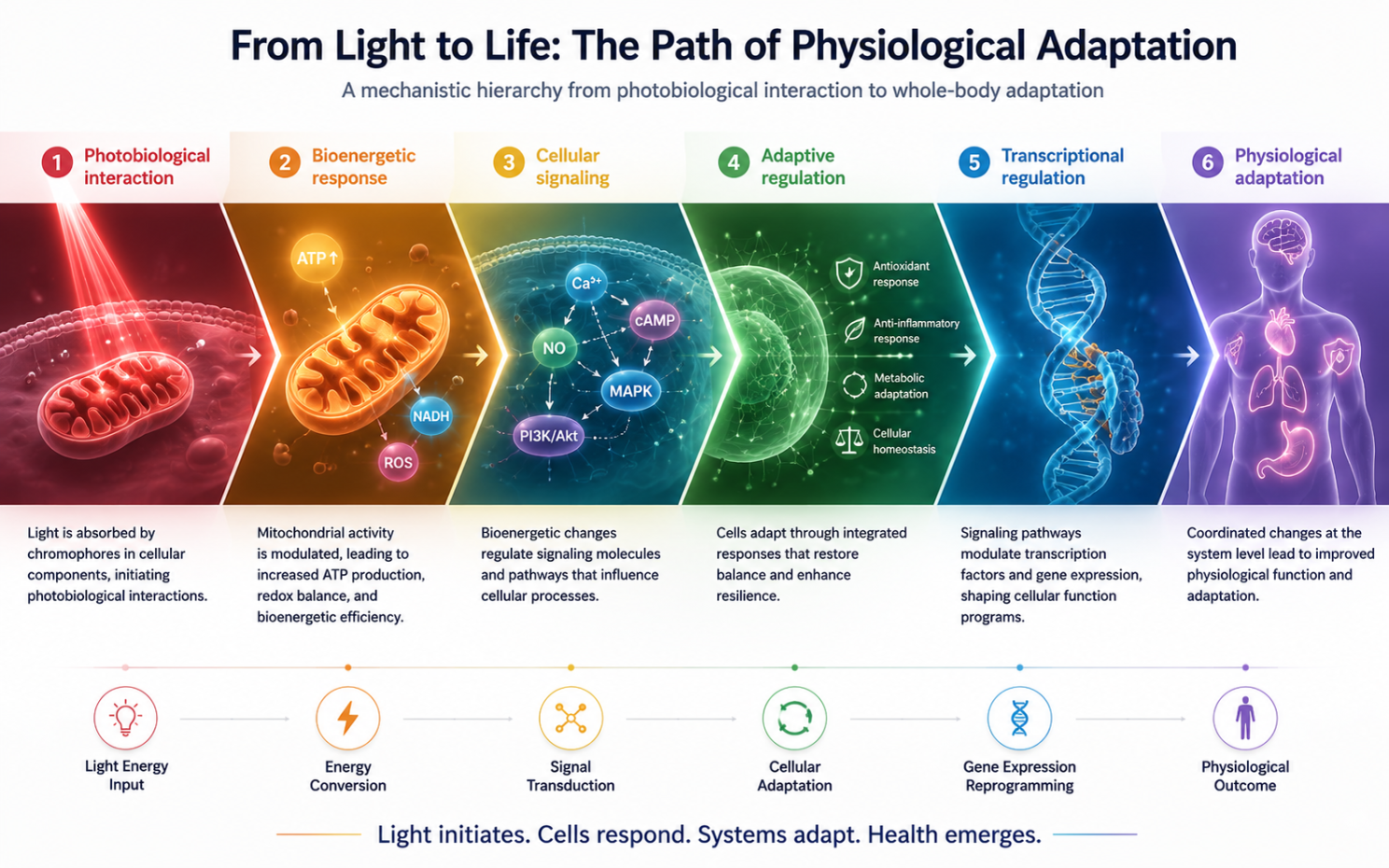
These mechanisms also unfold differently over time. Early photobiological events may occur within seconds or minutes. Bioenergetic and signaling responses develop over minutes to hours. Regulatory and transcriptional processes may extend across hours or days, while integrated physiological adaptation may emerge over longer periods.
At any given moment, different mechanisms within the hierarchy may occupy different stages of their own temporal processes. One response may already be declining while another is being amplified. A signaling process may remain active while transcriptional adaptation is still developing. Higher-order physiological changes may only be beginning to emerge.
The physiological system at any moment therefore reflects the interaction of multiple mechanisms occupying different temporal states.
From Mechanistic Hierarchy to Physiological Representation
This creates an important representation problem. At shorter timescales, relatively proximal molecular and cellular measurements may meaningfully reflect early responses to PBM. At longer timescales, however, individual mechanisms become increasingly insufficient for understanding the physiological system as a whole.
The underlying mechanisms remain important, but the physiological meaning represented by biomarkers depends on their temporal and mechanistic context. That is to say the biomarkers may remain the same; what they represent physiologically may not.
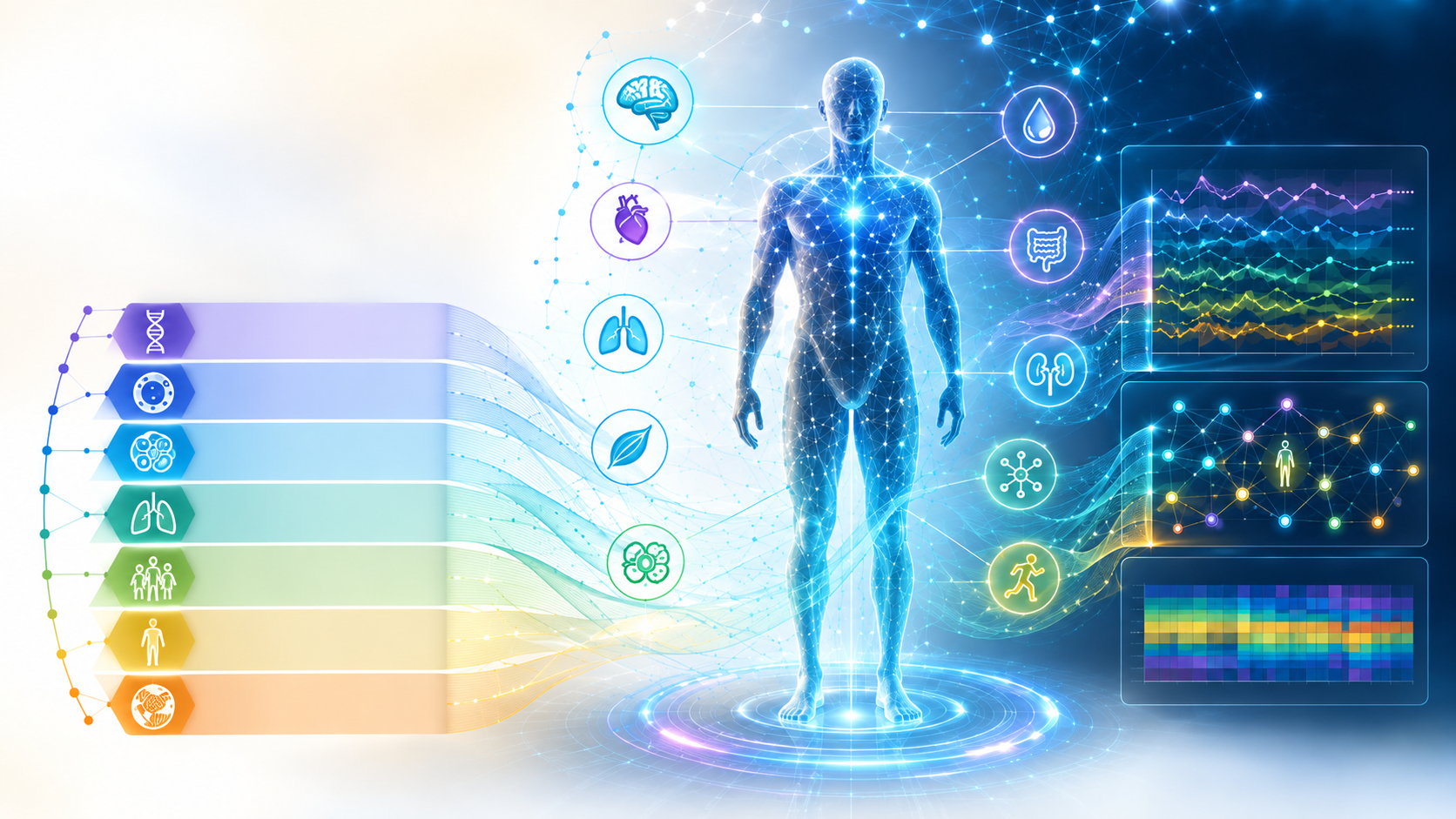
At each temporal cross-section, a multidimensional biomarker layer captures a particular configuration of the underlying mechanistic system. Some mechanisms may be activating, others adapting, others undergoing feedback, while still others are beginning to produce higher-order physiological effects.
The representation layer corresponds to physiology: it captures how this changing configuration of interacting mechanisms is expressed as a physiological state at a particular point in time. It is therefore neither another mechanistic layer nor simply a representation of disease. Its purpose is to characterize the organization and changing state of physiology.
For this reason, physiological representation is necessarily multidimensional and multisystem, potentially incorporating bioenergetic, metabolic, oxidative, immune, neuroplastic, cardiovascular, tissue-level, and functional domains.
But representation involves more than assembling biomarkers across these domains. It also requires understanding how biomarkers relate to one another, what their combined configuration represents physiologically, and how those relationships change over time.
A Temporal Cross-Section of Multiple Mechanistic Processes
A physiological representation layer can therefore be understood as a temporal cross-section of multiple interacting mechanistic processes. At the same measurement point, an early bioenergetic response may already be declining, a signaling process may remain active, transcriptional adaptation may still be developing, and higher-order physiological changes may only be emerging.
The biomarkers measured at that moment capture these different processes simultaneously—not as parallel mechanisms of equal meaning, but as different components of one physiological state. As time progresses, another cross-section captures a different configuration. Many of the biomarkers may remain the same, but the mechanistic states underlying them, their relationships with one another, and therefore their physiological meaning may have changed.
Physiological representation is thus not simply a biomarker panel repeated across time. It is a series of multidimensional cross-sections of an evolving physiological system, each reflecting a different temporal configuration of the underlying mechanistic hierarchy.
Modeling Systems-Level Physiological Representation
The next question is how this systems-level physiological representation can be modeled computationally.
Machine learning offers a natural bottom-up approach. Starting from multidimensional and longitudinal biomarker data, it can identify relationships among variables, detect changing patterns across time, and construct higher-order representations from observations.
Systems biology is increasingly exploring ways to combine such data-driven approaches with mechanistic and multiscale models.
Hybrid mechanistic–machine-learning approaches have been proposed to integrate biological knowledge with data-driven learning, while multiscale modeling provides a framework for representing biological processes operating across different organizational and temporal scales.
These developments provide an important methodological foundation, although their application to concrete systems-level physiological representation remains an emerging area.
The mechanistic hierarchy provides a complementary top-down biological framework. Rather than treating measured variables as a set of parallel features, it organizes them according to the biological processes and levels to which they relate. Its temporal structure further allows those measurements to be interpreted in relation to mechanisms that may be operating at different stages of their biological processes.
The two approaches therefore begin from different directions.
A top-down mechanistic framework begins with biological organization: how mechanisms are related, where they sit within the hierarchy, and how their processes unfold over time.
A bottom-up machine-learning model begins with observations: how multidimensional biomarkers relate to one another, how their configurations differ, and how those relationships change across repeated measurements.
Bringing these approaches together connects mechanistic organization with computational learning. The mechanistic hierarchy provides an interpretive architecture for patterns identified from data, while machine learning provides a computational means of examining how those patterns are expressed within real physiological measurements.
The purpose is not simply to model individual mechanisms or predict a clinical outcome. It is to model physiological regulation: how multiple biological processes, operating across different levels and temporal courses, are expressed through changing multidimensional physiological states.
This may also change how machine-learning results are interpreted. A statistical relationship between biomarkers need not be considered only as an association between variables; it can also be examined in relation to the mechanistic hierarchy, temporal structure, and physiological domains in which those measurements are embedded.
The challenge is therefore not simply to collect more data or build more complex models. It is how to organize, interpret, and model multidimensional observations while preserving as much of the structure of real physiological regulation as possible.
Systems-level physiological representation should not be equated with a systems mechanism. Mechanistic models seek to explain the biological processes underneath. Physiological representation addresses a different but connected problem: how those interacting processes are expressed, observed, and mathematically represented as a changing physiological system.
Mechanisms explain the processes underneath. Systems-level representation seeks to preserve the structure of physiological change that emerges from their interaction over time.
This article was first published in the Holistic Resonances newsletter on LinkedIn on August 19, 2026, and was adapted for Health Frontiers on Resonance. Read the original LinkedIn edition ↗
References
- Alber M, Buganza Tepole A, Cannon WR, et al. Integrating machine learning and multiscale modeling—perspectives, challenges, and opportunities in the biological, biomedical, and behavioral sciences. npj Digital Medicine. 2019;2:115.
- Procopio FA, et al. Combined mechanistic modeling and machine-learning approaches in systems biology: A systematic literature review. Computer Methods and Programs in Biomedicine. 2023;240:107681.
- Schmid PJ, et al. The rise of scientific machine learning: A perspective on combining mechanistic modelling with machine learning for systems biology. Frontiers in Systems Biology. 2024.