HEALTH & MIND · HEALTH FRONTIERS
Calcium as a Cross-System Interface
The signal moves, but its meaning comes from the living organization through which it moves.
Calcium is essential throughout the body. It participates in muscular contraction, vascular regulation, secretion, metabolism, immune responses, and nervous-system activity. Yet its significance is not fully captured by describing it simply as a substance present in different tissues.
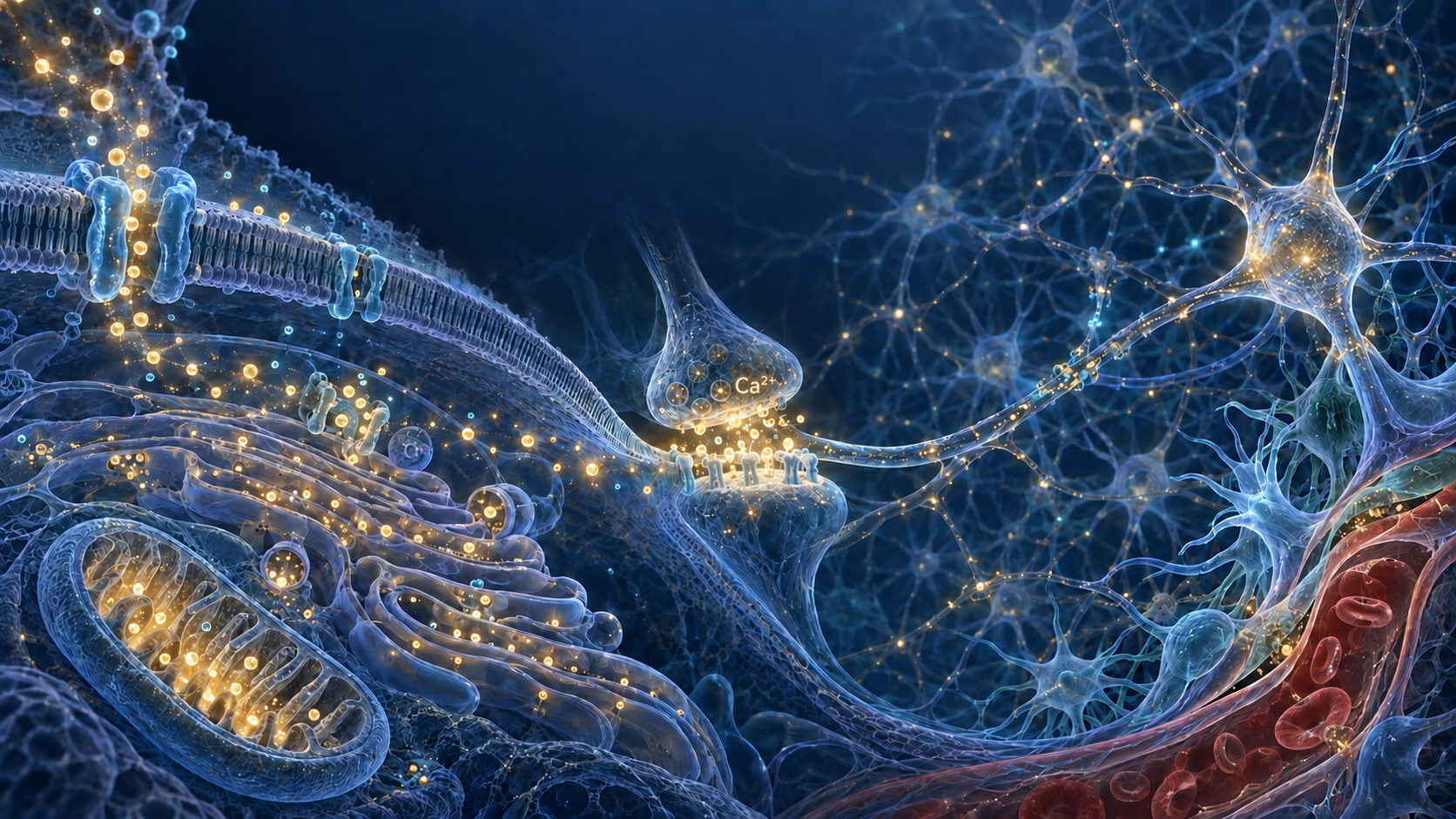
Calcium functions almost like a cross-system interface. This is a conceptual description rather than a formal biochemical definition. Calcium does not constitute a biological system by itself. Instead, calcium-mediated reactions help connect different systems and levels of biological organization. Within the natural physiological environment, subtle variations in calcium concentration, location, and timing allow Ca2+ to function as a dynamic interface, shaping how physiological responses emerge and propagate across different levels of neural organization.
Calcium as a Signalling Ion
When the focus is narrowed to nervous-system-centred organization, calcium can be described more precisely as a signalling ion. A calcium ion does not carry one fixed biological message. Its effect depends on where it enters, when it appears, how concentrated it becomes, how long the change lasts, and which cellular structures receive and regulate it.
At a presynaptic terminal, calcium influx helps convert electrical activity into neurotransmitter release. In a postsynaptic region, calcium participates in intracellular responses related to synaptic plasticity. Within mitochondria, calcium uptake and release help connect neural activity with local energy demand. The endoplasmic reticulum, plasma membrane, ion channels, mitochondria, synapses, and glial cells collectively determine the spatial and temporal form of calcium activity.
Calcium is therefore a dynamic signal whose meaning is organized by structure.
From Molecule to System
The same ion can participate in several levels of activity.
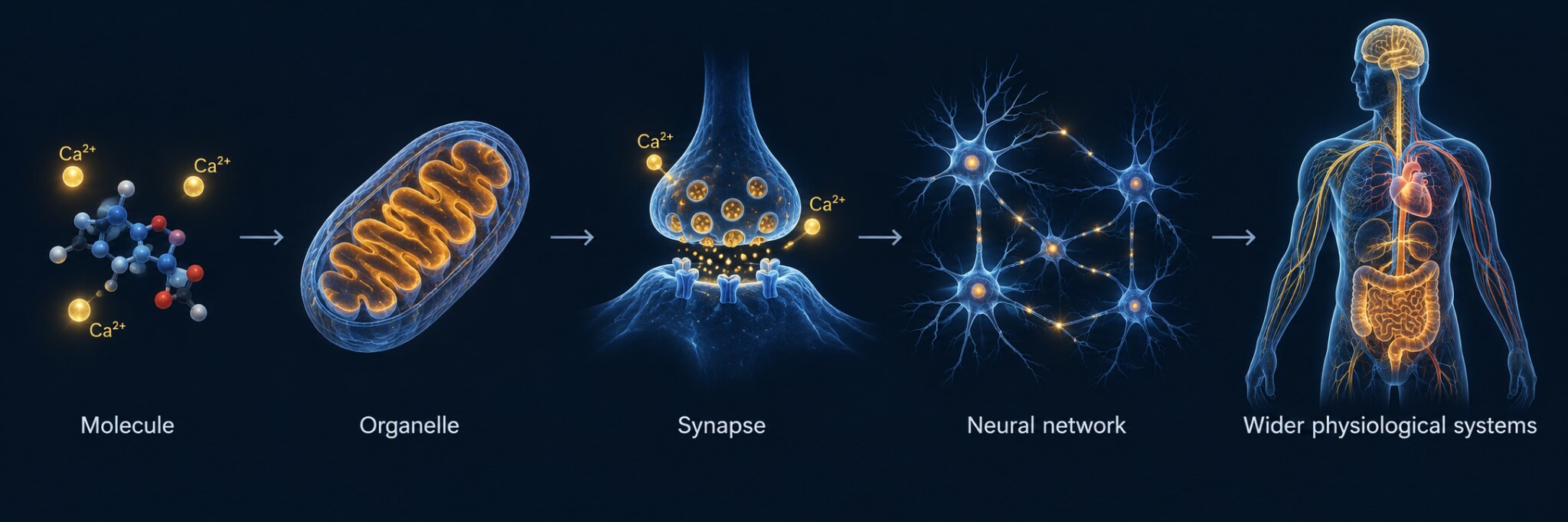
At the molecular level, calcium interacts with channels, transporters, receptors, and calcium-binding proteins. At the organelle level, mitochondria and the endoplasmic reticulum regulate calcium distribution and interpret changes in cellular demand. At the synaptic level, calcium participates in neurotransmission and plasticity. Across networks, coordinated patterns of cellular activity contribute to perception, action, memory, and cognition.
Calcium signalling also reaches beyond neurons. Glial cells, vascular processes, metabolic regulation, and immune activity all interact with nervous-system function. For this reason, “nervous-system-centred” does not mean “neurons alone.” It describes an organized physiological field in which neural activity remains central but depends upon surrounding systems.
Calcium operates across this field as both a signalling ion and a point of functional coordination.
Structure, Signal, and Constraint
The relationship between calcium and biological organization is reciprocal.
Calcium-dependent processes operate within broader system constraints. Neural signalling requires sufficient metabolic support, functioning mitochondria, appropriate ion gradients, available regulatory proteins, and the capacity to restore cellular balance after activation. The same calcium signal may therefore produce different consequences under different physiological conditions.
Neuroenergetic capacity is one such constraint. Neurons require energy to maintain membrane potentials, regulate ion movement, restore calcium balance, and sustain synaptic activity. When mitochondrial or metabolic capacity is limited, calcium signalling and recovery may also be altered.
Conversely, calcium availability, distribution, buffering, and regulatory capacity can themselves become constraints on neural function. Too little available signalling, excessive calcium entry, impaired buffering, or disrupted clearance can each change how the system responds.
Structure organizes the conditions under which calcium operates, but calcium regulation also helps determine what the structure can do.
Calcium and the Organization of Thought
This perspective may offer a cautious way of thinking about cognition.
A thought cannot be reduced to calcium activity. Thought belongs to a much higher level of organization than any individual ion, molecule, organelle, or synapse. Yet thought also does not occur independently of the physiological processes that sustain neural activity.
When an established neural pattern becomes active, calcium signals unfold within that organized pathway. These signals participate in the processes through which synaptic relationships are maintained, strengthened, modified, or weakened. Over time, calcium-dependent plasticity contributes to the biological conditions through which learning and memory become possible.
Calcium does not contain a thought. Rather, calcium dynamics participate in the physiological organization of the nervous system through which thought is biologically expressed.
Individual Elements Within a Living Structure
This way of seeing calcium also raises a broader question: how does an individual element acquire meaning within a living system?
Calcium operates through multiple molecular mechanisms and can function as a physiological interface across different processes and systems. Yet examining an individual calcium channel or signalling pathway in isolation tells us relatively little about its function within the living nervous system. That function depends not only on the channel or pathway itself, but also on the spatial and temporal dynamics of Ca2+, its relationships with other processes, and the state and constraints of the wider system in which it operates. The same principle extends across biological organization: molecules form complexes, organelles coordinate cellular activity, synapses participate in neural networks, and neural systems operate within the physiological life of the whole organism.
The meaning of an element is not found only in what it is made of, but also in the structure of relationships through which it functions.
This does not erase individuality. It explains how individuality becomes functional.
Calcium is therefore more than an ingredient distributed throughout the body. Within nervous-system-centred activity, it is a signalling ion. Across biological levels, it can also be understood as a physiological interface—linking molecular events with organized neural, bioenergetic, and wider physiological responses.
The signal moves, but its meaning comes from the living organization through which it moves.
Further reading
Brini M, Calì T, Ottolini D, Carafoli E. Neuronal calcium signaling: function and dysfunction.
Walters GC, Usachev YM. Mitochondrial calcium cycling in neuronal function and neurodegeneration.