HEALTH & MIND · HEALTH FRONTIERS
The Way of Structure · II
Ancient Chinese Systems Thought and Physiological Modelling
From a modern scientific perspective, Zi Wei Dou Shu may be read as a psychometric-like psychological inference system—not psychometrics in the modern technical sense, but an old attempt to derive individualized tendencies and patterns from accumulated observation, experience, and inference about both visible and less directly observable human states.
What interests me most, however, is not whether a particular star corresponds to a personality trait, a gene, or a physiological pathway.
It is the structure of transformation.
The Structure of Transformation
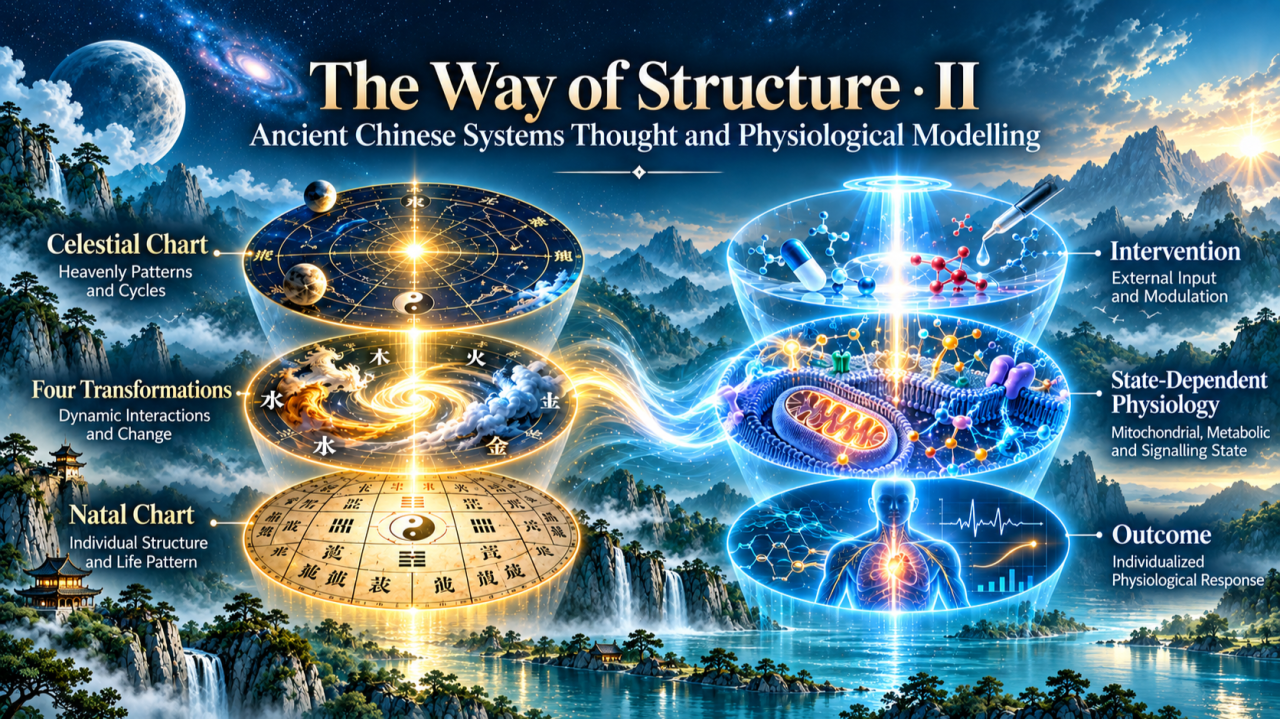
Zi Wei Dou Shu does not simply move from an external celestial configuration directly to an individualized result. Between them lies another layer:
Celestial Chart → Four Transformations → Natal Chart
A comparable architecture appears in modern intervention research:
Intervention → state-dependent physiological transformation → outcome
I am not suggesting that these two systems contain the same concepts, mechanisms, or substances. The comparison is structural. In both, an input does not simply become an individualized expression by itself. Something in between changes how it can be expressed.
That is what I mean by The Way of Structure.
The Four Transformations and System Constraint
The Four Transformations—Hua Lu, Hua Quan, Hua Ke, and Hua Ji—are particularly interesting from this perspective.
Their role can be described as a differentiated transforming influence that constrains and redirects how the original celestial configuration becomes expressed in the Natal Chart.
This is why they remind me of system constraints.
A constraint does not necessarily have to be another visible object or measurable component. It may instead describe the way an existing system makes some pathways more available, others less available, and certain directions of change more probable.
This becomes easier to see in physiology.
An intervention enters a body that already has a mitochondrial state, metabolic reserve, membrane potential, redox balance, immune and endocrine conditions, signalling dynamics, genetic background, tissue architecture, and a history of previous adaptation. These factors interact. Some responses may be amplified; others may be suppressed, saturated, compensated for, or redirected.
A general mechanism tells us how an intervention can act biologically. It does not necessarily explain why the same intervention produces different effects in different individuals.
general mechanism + state-dependent physiology → individualized response
Physiology can increasingly be measured. Mitochondrial function, metabolites, inflammatory markers, ion dynamics, neural activity, and many other components can be represented experimentally.
Yet the constraint of the whole system may still not be reducible to one biomarker or one pathway. It is embodied in the organization and interaction of the physiological system.
In this sense, the Four Transformations resemble the constraint concept more closely than they resemble physiology itself, while physiology provides the biological layer through which such constraints become expressed.
Why Structure Matters
The point of structural comparison is not that different systems are secretly identical.
A cell is not a person. A family is not a state. A physiological system is not a celestial chart.
But very different systems may still organize change through comparable relationships.
The Dao De Jing famously moves across levels of organization:
以身觀身,以家觀家,以鄉觀鄉,以國觀國,以天下觀天下。From the individual to the family, community, state, and world, the material content changes dramatically, yet comparison across scales remains possible.
The Zhuangzi similarly reflects an intuition that differences in scale and multiplicity do not necessarily eliminate recurring principles of transformation and organization.
This is the sense in which structure itself can carry information.
Different domains may repeatedly contain relationships such as:
input → constraint → transformation → expression
The “way” is therefore not sameness of content, but a potentially recurring organization of change.
Ancient Calculation Was Still Calculation
Ancient calculation should not be confused with an absence of mathematics simply because it did not use modern Hindu-Arabic notation.
Chinese mathematical traditions developed their own numerical representations, computational procedures, calendrical systems, and written algorithms. Zi Wei Dou Shu itself is highly rule-governed, combining time, stars, palaces, Heavenly Stems, Earthly Branches, and transformations into individualized configurations.
Likewise, the Five Movements and Six Qi framework of the Huangdi Neijing uses a different but related calendrical-cosmological grammar. It is not the same computational system as Zi Wei Dou Shu, but both draw on cyclical time, stems and branches, and relational transformation.
Western astrology provides another useful comparison. Its computational grammar is different again—organized through the ecliptic zodiac, planets, houses, and aspects—but it also interprets celestial conditions relationally rather than reducing them to the isolated effect of a single celestial object.
The arrangements differ. The broader systems impulse is recognizable.
From Observation to Pattern Learning
The more interesting methodological connection may be how these systems were formed.
Like traditional Chinese medicine, ancient classificatory systems developed through repeated observation. Differences were noticed, recurring patterns were retained, and those patterns were organized into rules for interpreting new cases.
At that level, the reasoning pathway resembles one basic logic of machine learning:
observation → recurring pattern → classification → inference
This does not mean that Zi Wei Dou Shu was machine learning in a modern technical sense. Ancient observers had limited instruments, limited datasets, and far less observational resolution.
The resemblance lies in the direction of inference: recurring observations are used to infer structure.
Historical exchange between Chinese and Indian intellectual and medical traditions is well documented. This makes their different classificatory styles interesting to compare.
Metaphorically, the contrast sometimes resembles xieyi (寫意) and gongbi (工筆) in Chinese painting: one preserves a broader relational form, while the other differentiates internal structure more finely. Some Chinese systems often retain relatively broad categories; traditions such as Ayurveda can elaborate the inferred middle layer into much finer constitutional classifications.
Under limited empirical resolution, a broader framework may sometimes have greater transferability. Greater detail can increase explanatory richness, but it can also introduce distinctions that cannot yet be independently tested—a problem modern modelling would recognize as a risk of over-specification.