HEALTH & MIND · PERSPECTIVES & DISCUSSIONS · 01
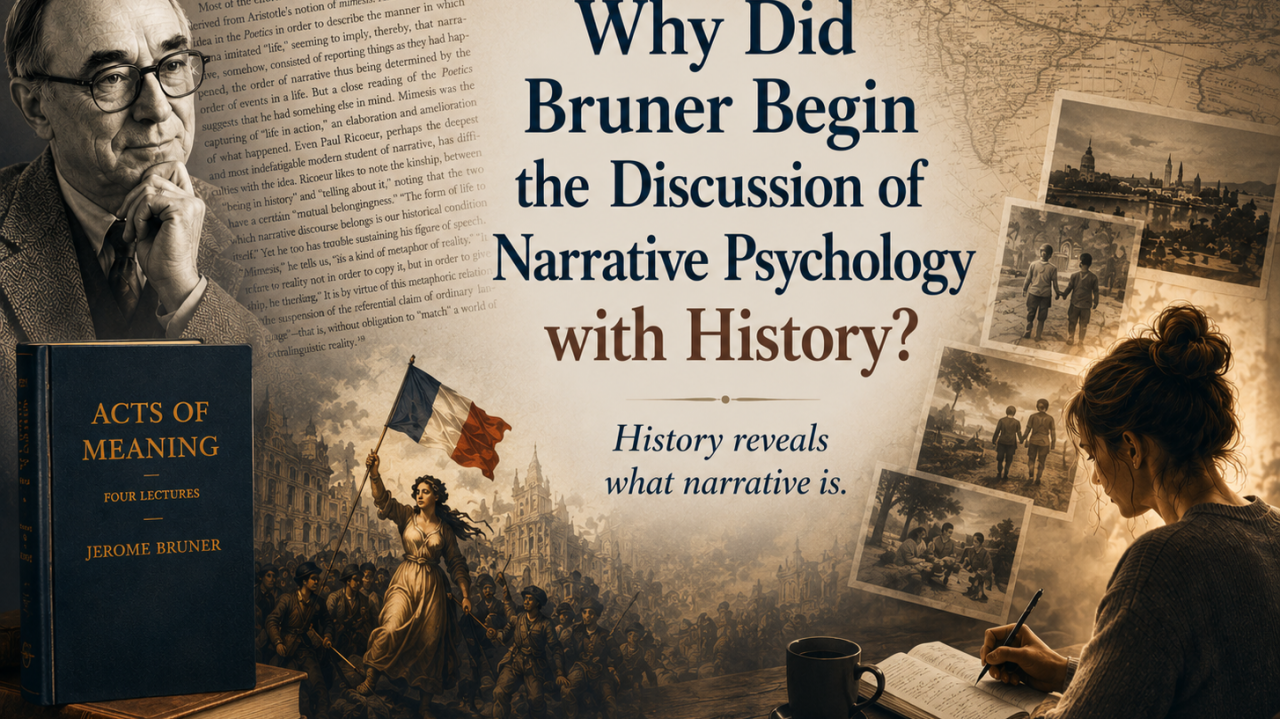
Why Did Bruner Begin the Discussion of Narrative Psychology with History?
History reveals the interpretive nature of narrative. Lived experience reveals the cognitive organization that precedes it.
Jerome Bruner (1915–2016) was an American psychologist whose work helped shape the cognitive revolution and later contributed substantially to cultural and narrative psychology. Across books including The Process of Education (1960), Actual Minds, Possible Worlds (1986), Acts of Meaning (1990), and The Culture of Education (1996), he examined how human beings learn, organize experience, and construct meaning through culture and narrative.
When I read Bruner’s Acts of Meaning, one question naturally came to mind: if narrative psychology is ultimately concerned with how people make sense of their lives, why begin with historians rather than with ordinary people’s life stories?
Why history?
Perhaps because history is one of the easiest places to see what narrative really is.
Take the French Revolution. The events themselves do not change, yet historians have interpreted them in remarkably different ways. A Marxist historian may describe it as a class struggle. A liberal historian may see it as the birth of modern democracy. A conservative historian may emphasize the collapse of social order. The historical events remain, but the narratives differ because their organizing perspectives differ.
Narrative as interpretation
Narratives are not simply mirrors of reality. They are interpretations of reality.
This was the point Bruner developed through Aristotle’s concept of mimesis and Paul Ricoeur’s distinction between being in history and telling about it. Narrative is not a neutral recording of events. It selects, relates, and reorganizes events into a meaningful account.
History offers a particularly visible demonstration of this process. Historical narratives can also be compared with multiple sources. Different witnesses, documents, and material evidence create opportunities for interpretation to be examined and revised. Complete objectivity remains impossible, but competing accounts can be confronted with a shared evidentiary field.
From history to lived experience
Once we move from history to lived experience, however, the problem becomes more difficult. There is rarely an external archive against which a personal narrative can be directly compared. More importantly, lived experience is filtered through cognitive processes long before it is narrated.
Attention, memory, appraisal, attribution, emotional state, and prior beliefs all shape how an experience is encoded, retained, recalled, and eventually told. By the time a life story becomes narrative, it is already the product of cognitive organization rather than a direct record of experience.
The central question is therefore no longer only what happened, but also how experience was cognitively organized before it became narrative.
The next challenge for narrative psychology
Understanding narrative may require more than interpreting stories themselves. It may also require closer attention to the cognitive processes that organize experience into stories in the first place.
DISCUSSION
If narrative reflects cognitive organization rather than experience itself, one of the next challenges for narrative psychology may be to develop methods that explicitly characterize this organization, rather than focusing solely on narrative meaning or content.
Originally published on LinkedIn ↗.
← BACK TO PERSPECTIVES & DISCUSSIONS