HEALTH & MIND · PERSPECTIVES & DISCUSSIONS
The Way of Structure · I
Ancient Natal Chart and Modern Psychology
Human beings have always tried to understand why apparently similar experiences produce very different people.
Two individuals may encounter comparable rejection, opportunity, uncertainty, loss, or affection, yet the psychological consequences can be strikingly different. Even within the same individual, a similar event at two different points in life may produce a very different response.
Modern psychology offers many ways to investigate this heterogeneity. Ancient systems approached the question through very different languages and assumptions. I am not interested in collapsing one into the other. A natal chart is not a psychological model, and an ancient celestial category should not be translated directly into a modern cognitive variable.
What interests me is something more basic: the structure through which an initial condition becomes an individualized expression.
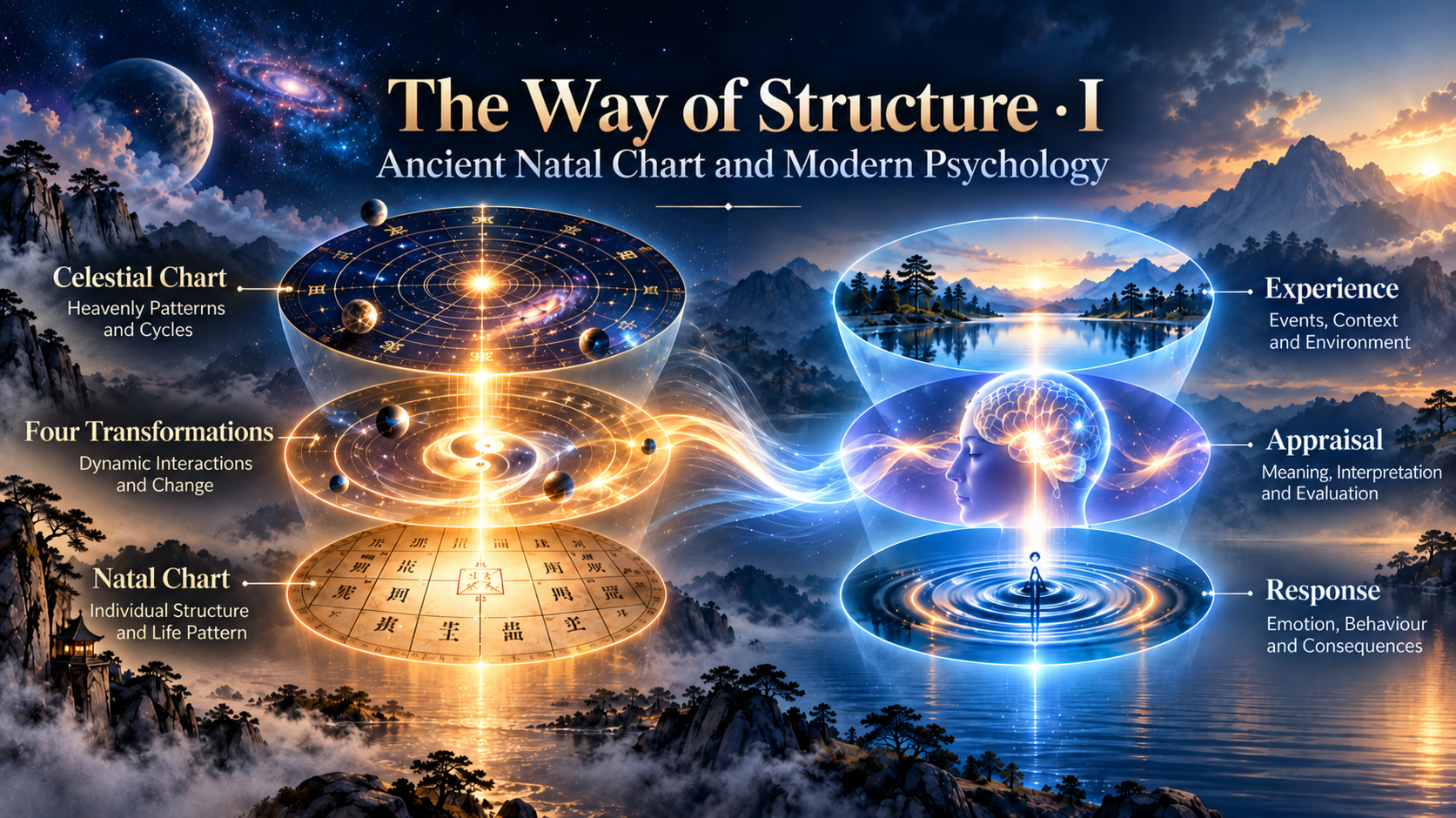
From this perspective, Zi Wei Dou Shu offers an intriguing three-layer architecture:
Celestial Chart → Four Transformations → Natal Chart
A comparable structure appears in modern psychology:
Experience → Appraisal → Response
The concepts, mechanisms, and evidentiary foundations are different.
Why do the two ends not correspond directly? What happens in the middle?
That is the starting point of The Way of Structure.
A Psychometric-Like Inference System
From a modern scientific perspective, Zi Wei Dou Shu can be viewed as a psychometric-like psychological inference system.
This does not mean that it is psychometrics in the contemporary technical sense. Modern psychometrics requires explicit constructs, measurement models, reliability, validity, calibration, and empirical testing. Zi Wei Dou Shu was developed in a very different historical and epistemic environment.
Yet its function has a recognizable psychological character. It uses a highly rule-governed system to derive an individualized configuration of tendencies, relationships, dispositions, patterns of action, and possible life expressions from a predefined set of temporal and celestial relationships. In that sense, it attempts to represent something more complex than a prediction of isolated events: it constructs an individualized pattern.
The most interesting question is therefore not which ancient star corresponds to which modern trait. That approach would almost certainly be too literal. The more productive question is: what kind of structure did the ancient system use to explain how a general configuration became an individual pattern?
This is where the Four Transformations become especially important.
The Transformational Middle
Zi Wei Dou Shu does not simply move from celestial configuration to Natal Chart. Between the two lies the layer of the Four Transformations—Hua Lu, Hua Quan, Hua Ke, and Hua Ji.
Their structural role can be described as a differentiated transforming influence that constrains and redirects how the original celestial configuration becomes expressed in the Natal Chart.
This is different from treating them as another collection of objects in the chart. Their importance lies in what they do within the structure.
They imply that the original condition is not expressed identically or directly. Something modifies its direction, relational effect, or mode of manifestation before the individualized configuration appears. This is why I think of the Four Transformations as occupying a transformational middle.
The middle is important precisely because it creates differentiation.
initial condition → transformation → individualized expression
That additional layer changes the logic of the entire system.
A Comparable Problem in Psychology
Modern psychology confronts a structurally similar problem. An Experience does not necessarily produce a Response directly.
Consider criticism. One person may interpret criticism as useful information. Another may experience it as humiliation. Another may hear the same words primarily as rejection. A fourth may react defensively without being able to articulate what the event meant to them.
The external event can be similar while the responses diverge dramatically.
Between Experience and Response lies Appraisal: the process through which the event acquires psychological meaning.
Experience → state- and history-dependent Appraisal → Response
Appraisal may involve memory, expectations, perceived threat, perceived control, prior learning, attentional bias, beliefs, self-concept, social meaning, and current emotional or physiological state.
Some appraisal is consciously accessible. Some can be verbalized only partially. Some may occur rapidly enough that the person experiences the emotional or behavioural reaction before they can clearly describe how the event was evaluated.
This is why Appraisal is much more than a spoken thought. It is a transformational cognitive layer through which an Experience becomes personally meaningful.
The EAR Chain Is Complete in Theory but Fragmented in Practice
The theoretical structure seems straightforward: Experience → Appraisal → Response. But the practical research problem is much more difficult.
Experience and Response are relatively externally anchorable. An Experience may have a time, place, interpersonal context, or identifiable trigger. A Response may appear in behaviour, language, emotional expression, avoidance, decision-making, physiological activation, or another consequence.
Appraisal is different. It is less directly observable.
A person can report what they believed they were thinking, but the reported appraisal does not necessarily provide a complete representation of the cognitive organization that actually connected the event to the response.
The person may recognize the appraisal clearly, recognize only part of it, or give a retrospective explanation after the response has already occurred. They may sincerely believe one interpretation while repeated behavioural patterns suggest that another evaluative process is also operating.
None of this means that the person is being dishonest. It means that self-report is one window into appraisal, not appraisal itself.
Although EAR is theoretically one continuous chain, practice often fragments it into partial relationships:
Experience → Appraisal Appraisal → Response Experience → Response
Psychology can therefore possess a theoretically integrated model while lacking an equally integrated representation of the process in an individual person. The challenge is to reconstruct that continuity over time.
From an Episode to a Pattern
One isolated episode tells us relatively little. A person experiences an event, reports an interpretation, and produces a response. That single observation may be meaningful, but it remains highly ambiguous.
The situation changes when the same person contributes many episodes across time.
E₁ → A₁ → R₁
E₂ → A₂ → R₂
E₃ → A₃ → R₃
…
Now the question is no longer simply what this person thought in one situation. It becomes: what recurring relationship connects particular kinds of Experience, Appraisal, and Response in this person?
This is the basis for idiographic longitudinal modelling. Idiographic means that the primary unit of understanding is the individual pattern rather than a population average. Longitudinal means that the pattern is reconstructed through repeated observations across time.
This is particularly appropriate for EAR because the middle layer is difficult to capture directly. Repeated episodes allow the structure itself to become informative.
Modelling in Both Directions
A forward analysis begins with Experience: what kinds of Experience repeatedly lead to which Appraisals, and which Responses tend to follow?
A backward analysis begins with Response: when this Response repeatedly occurs, what kinds of Experience preceded it, and what Appraisal could plausibly have mediated the relationship?
Reported Appraisal provides another source of evidence. The aim is not to declare that one direction reveals a person’s “true cognition.” Instead, repeated episodes allow comparison among Experience, reported Appraisal, appraisal patterns tentatively inferred from recurring E–R relationships, and Response.
The scientific interest lies in their coherence and discrepancy over time.
Suppose that an individual repeatedly reports that criticism “does not matter,” yet criticism is consistently followed by withdrawal, rumination, reassurance seeking, or defensive behaviour. That discrepancy is itself information.
It may indicate that the verbal account captures only part of the appraisal process. It may reflect an automatic evaluation, a learned response, a conflict between conscious belief and rapid affective appraisal, or simply an inadequacy in the available description.
The pattern does not tell us automatically which explanation is correct. But it tells us where the psychological structure requires closer examination.
Why Natural Language Matters
Much of human psychological experience does not arrive as standardized numerical data. It arrives as narrative.
People describe what happened, what they thought it meant, what they felt, what they did, and how they later interpreted the event. These accounts are temporally distributed and linguistically variable. That makes longitudinal comparison difficult.
This is where LLM-assisted semantic analysis may have a useful but bounded role.
The purpose is not for an LLM to decide what a person “really thinks.” Rather, it can help identify and longitudinally index the structural elements of repeated EAR episodes so that comparable Experiences, reported Appraisals, recurring appraisal themes, and Responses can be organized consistently across time.
The value of the model lies in the repeated structure—not in any single machine-generated interpretation.
An LLM in this context functions less as an oracle and more as a semantic organizing instrument.
Cognition as the Hidden Middle
Viewed this way, EAR becomes fundamentally a way of investigating cognition.
E→A asks how experience becomes cognitively represented. A→R asks how that representation becomes emotional or behavioural expression. E→R asks what recurring relationship remains visible even when appraisal is incomplete, unreported, or difficult to articulate.
The middle is therefore both the problem and the research object.
Appraisal is what makes the model psychologically meaningful, yet it is also the component that is least directly accessible. That is precisely why longitudinal structure matters.
The aim is not to replace subjective experience with computation. Nor is it to assume that every psychological process can eventually be reduced to one score. It is to make a partially hidden transformation progressively more representable.
An Older Structural Intuition
Ancient Chinese systems often began with observation of nature, embodied experience, and recurring patterns in lived life.
Their observations were not standardized in the modern scientific sense. They relied heavily on perception, accumulated experience, felt differences, and interpretive traditions. The inference from repeated observation toward an underlying organizing structure was therefore much looser than modern empirical modelling.
The resulting categories could be ambiguous, difficult to verify, or impossible to map directly onto contemporary scientific variables.
But the structural intuition can remain interesting: an observable condition and an individualized expression may be connected through a less visible process of transformation.
Zi Wei Dou Shu formalized this intuition in one particular way. Modern EAR begins from a different evidentiary position.
Experience can usually be anchored to an identifiable event or context. Response can often be observed. Appraisal is theoretically positioned between them as a cognitive process, and repeated longitudinal data make that middle increasingly open to empirical examination.
So the ancient and modern systems are not equivalent, nor is one a scientific version of the other. What they share is a structural problem: the two ends do not correspond directly because an intermediate transformation produces heterogeneity and individualization.
Why Structure Itself Matters
This kind of reasoning also resonates with an old Chinese idea of comparing patterns of organization across different levels.
The Dao De Jing moves from the individual to the family, community, state, and world:
以身觀身,以家觀家,以鄉觀鄉,以國觀國,以天下觀天下。A person is not a family. A family is not a state. And a Natal Chart is certainly not a psychological model.
The comparison only becomes useful when we stop demanding sameness of content. Different systems may contain different entities and still share a comparable organization of transformation.
That is the point of The Way of Structure.
The Four Transformations are not Appraisal. A Natal Chart is not a psychological phenotype. But both structures insist that an individualized result cannot be understood simply by looking at the initial condition.
The middle matters.
From “What Happened?” to “How Was It Transformed?”
Psychology often begins with observable questions: what happened, and how did the person respond?
EAR adds another: how did what happened become meaningful enough to produce that response?
That question shifts attention from events alone to transformation.
Once transformation becomes the focus, other questions follow. What parts of Appraisal are consciously accessible? Which patterns remain stable across situations, and which change with context? Where does reported Appraisal agree with recurring behaviour, and where does it diverge? How does previous experience alter the appraisal of a new experience?
And when psychological change occurs, does it begin with a different Experience, a different Appraisal, a different Response—or a reorganization of the relationship among all three?
These are longitudinal questions. They are also questions of structure.
What is this hidden middle? How does it individualize the relationship between Experience and Response, and how can it be progressively represented over time?
That is the question I want The Way of Structure to explore.