 FORTHCOMING · OCTOBER 1, 2026
CULTURE & MEANING · LANGUAGE & SYMBOLS
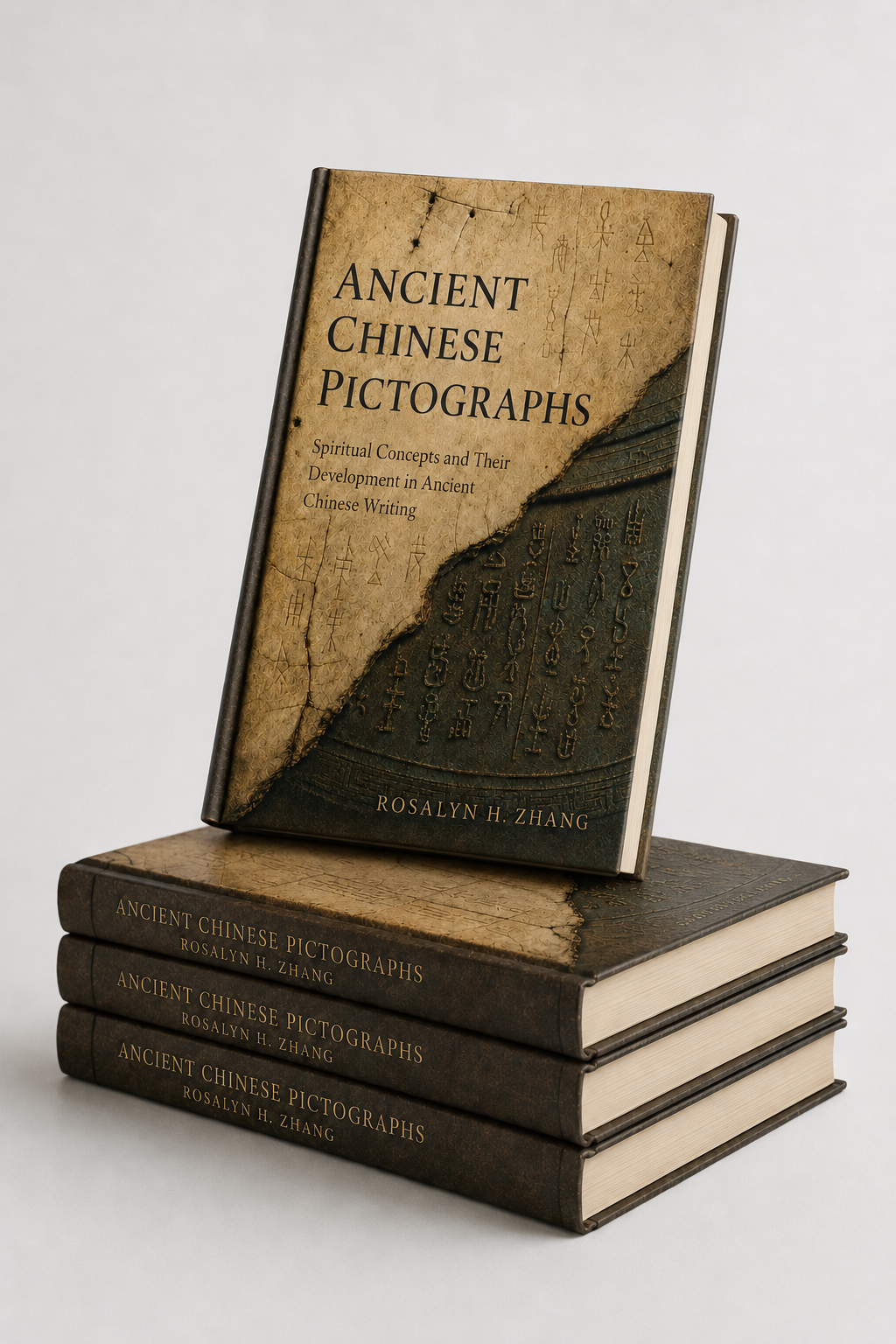
Ancient Chinese
Pictographs
Spiritual Concepts and Their Development in the Ancient Chinese Language
A historically grounded invitation to reconstruct ancient characters within their developing contexts of graphic form, pronunciation, and meaning—and to read them as archaeological witnesses to an earlier linguistic, cultural, and spiritual world.
Rosalyn H. Zhang
ABOUT THE BOOK
The characters survived.
What was lost around them?
Across thousands of years, Chinese characters remained visible while their forms, pronunciations, meanings, materials, and interpretive settings changed. The earliest inscriptions were not transmitted through a continuous scholarly tradition: the objects survived, but much of the knowledge structure and cultural background needed to read them in their original setting did not.
Ancient Chinese Pictographs therefore follows three connected histories—the history of written forms, the history of spoken pronunciation, and the history of meaning. It brings oracle-bone inscriptions, bronze writing, historical phonology, archaeology, ritual history, and transmitted texts into conversation without assuming that any one source provides a complete answer.
The second part turns to individual characters and graphic relationships involving light, water and ritual immersion, inner practice, kingship, identity, spirit-related forms, and a carefully bounded cross-cultural comparison. The book does not treat visual resemblance as proof or present exploratory readings as settled history. Established evidence, reconstructive reasoning, and new pictographic hypotheses remain visibly distinct.
THE APPROACH
Characters survived.
Their interpretive world did not always survive with them.
01Graphic historyEarly forms are examined across oracle bones, bronze vessels, and later standardized scripts.
02Language historyWritten continuity is separated from changing pronunciation and reconstructed Old Chinese.
03Cultural contextRitual, divination, ancestry, philosophy, and transmitted texts provide context without being collapsed into one category.
04Interpretive limitsEstablished evidence, plausible reconstruction, and exploratory comparison remain visibly distinct.
CONTENTS
From historical method
to individual words.
PART ISpiritual Concepts in the Ancient Chinese LanguageChapters 1–4 establish the historical, linguistic, paleographic, ritual, and textual framework.
PART IIThe WordsChapters 5–11 examine selected forms and carefully bounded interpretive and comparative questions.
Why Early Chinese Writing Can Be Re-examined
Why surviving graphic forms remain open to careful historical and paleographic investigation.
The Development of Early Chinese Language and Writing
How changing media, scripts, regions, and pronunciations complicate the path from ancient forms to modern Chinese.
Why Language Also Has a Spiritual History
Oracle-bone writing within ritual, divination, ancestral communication, and the conceptual world of the Shang court.
A Contextual Window into Early Pictographic Writing
How transmitted texts, including the Dao De Jing, may preserve contexts relevant to questions raised by much earlier graphic evidence.
Two Possible Kinds of Light: 先 and 光
An exploration of early graphic forms and two potentially different conceptions associated with light.
A Possible Ritual Image in 沖
A cautious reconsideration of graphic structure, ritual action, and later semantic development.
專/摶: An Ancient Image of Inner Practice
From the action of turning a spindle to an embodied image of gathering breath, attention, and bodily state.
王: From Royal Sovereignty to an Imperial Rank
How a recognizable graph outlasted major transformations in political authority, ritual mediation, and royal status.
A Possible Ark-like Image in 吾
An inquiry into oracle-bone and bronze forms, the layered Mao Gong Ding graph, and the distinction between 吾 and 我.
A Recurring Structure in Spirit-Related Pictographs
A recurring one-, two-, and three-unit structure examined across selected forms associated with spirit-related concepts.
A Possible Comparison: 夷・希・微 and YHWH
A historically bounded comparison involving textual transmission, Old Chinese reconstruction, YHW, and an earlier hypothesis.
FOR THE CURIOUS READER
A book for readers interested in language, culture, history, and spiritual ideas.
This work is written for readers who are willing to remain with evidence and uncertainty at the same time. It may be of interest to those exploring Chinese cultural history, the development of writing, historical linguistics, early spiritual concepts, Daoist texts, comparative traditions, or the ways cultural memory can survive unevenly across time.
Forthcoming edition: The central inquiry and chapter structure are established. Final wording is still being refined, and the published edition may further develop the book’s cultural positioning and contextual framing.
Amazon link coming soon · Launching October 1, 2026